The feedback you give your AI writing tool is quietly training it to sound like everyone else on LinkedIn
Kartick Narayan
June 12, 2026 · 5 min read
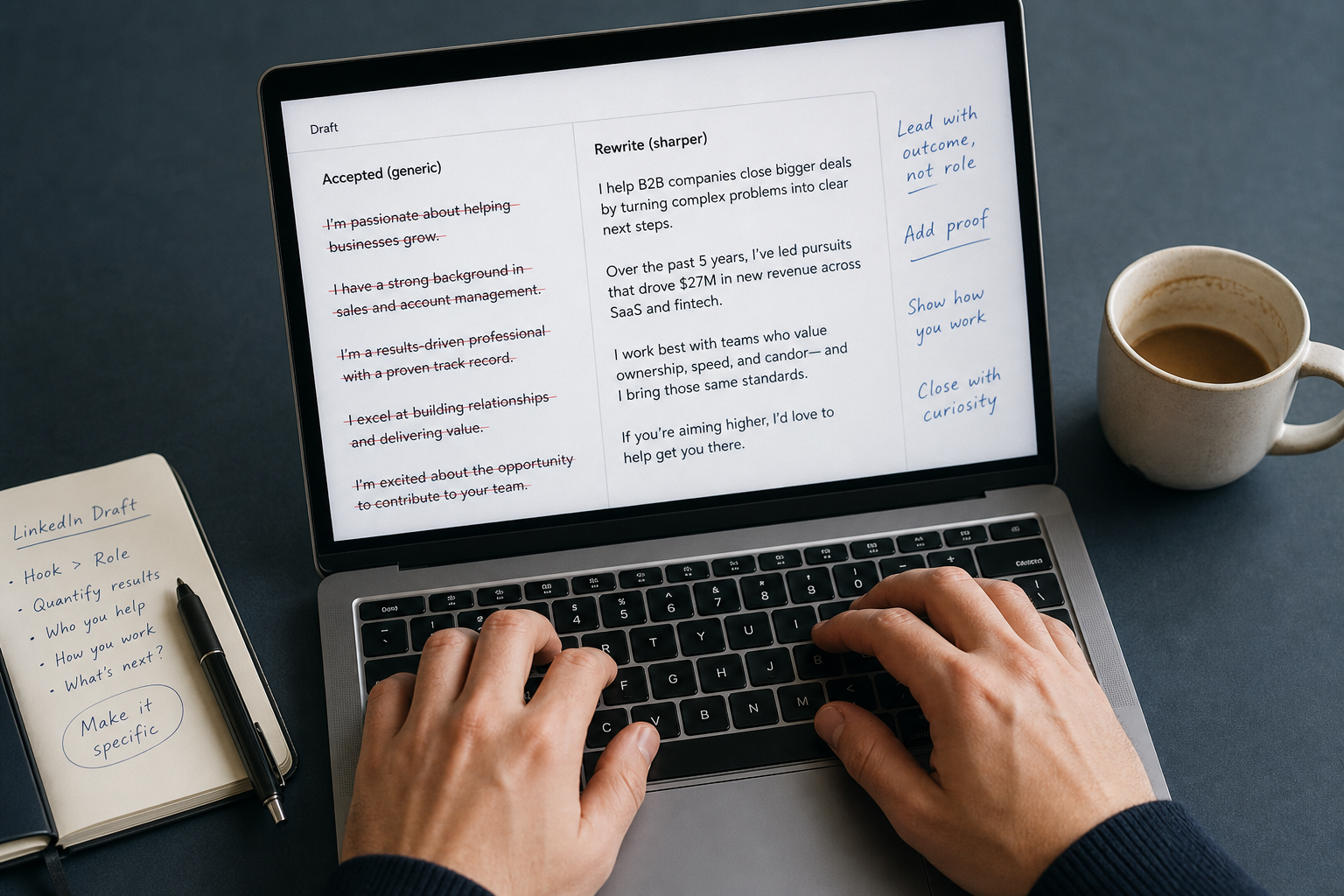
Every time you accept an AI suggestion without editing it, you're voting for a blander version of your own voice.
The editing itself is not the problem. A founder who spends 45 minutes reworking a LinkedIn draft is doing exactly what good writers do. They are closing the gap between a machine's guess and their actual thinking. The problem is what happens to those edits after they leave your screen.
They disappear.
The feedback loop you never see
The conventional view is that AI writing tools get better at tone because the underlying models improve. If your content sounds more like you over time, the thinking goes, that is because the AI is becoming more sophisticated. This is a reasonable belief. It is also wrong.
The feedback loop that actually shapes your output is the one you never see. When you accept a bland phrase without changing it, the tool registers that as a win. When you quietly delete a sentence and replace it with something sharper, the tool never records the difference. The standard AI model sees your accepted outputs, not your rejected ones. It learns from your approvals, not your judgment.
Think about what that means in practice. You write ten LinkedIn posts over a month. Each time, you tweak the AI draft heavily, cutting the corporate phrasing, adding the specific detail, changing the opener because it sounds like everyone else's opener. Then you hit publish. The tool saw none of that. It saw the final approved post, stripped of all the context about what you rejected and why. Post eleven starts from the same baseline as post one.
What the tool is actually learning
Every edit you abandon to save time is a quiet vote for the generic version.
So the tool does not drift toward your voice over time. It drifts toward the average of every LinkedIn post that got accepted without resistance across every user. That average has a distinct texture: structured, safe, and completely interchangeable with the post published by your nearest competitor this morning.
The symptoms are recognizable if you have been using AI writing tools for any length of time. The posts feel vaguely correct but not quite yours. The sentence rhythms are smooth but somehow flat. You fix it every time, and every time you are fixing the same things, because the tool has no record of what bothered you before.
This is not a capability problem. It is an architecture problem. The model is not failing to understand your voice. It is never being asked to learn it in the first place.
Why "just edit more carefully" misses the point
The instinct is to fix this through discipline. Edit harder. Be more specific in your prompts. Write a longer brief. Add examples of your tone in the system prompt and hope it sticks.
These approaches have real limits, and founders hit them fast.
A longer brief helps once. It does not compound. You write a detailed prompt describing your voice, the AI produces something slightly closer to your style, you still edit it, and then the next session that brief sits there unchanged while your actual writing has moved on. Your prompts are static. Your voice is not.
The same problem shows up with style guides built into system prompts. They capture your voice as it was when you wrote the guide, not as it is now. A founder six months into writing on LinkedIn sounds different from the founder who first sat down to describe their tone. The style guide does not know that. The brief does not know that.
Hard editing in isolation is also expensive in a way that quietly defeats the purpose of using the tool. If you are spending 40 minutes fixing a 200-word LinkedIn post, the AI is not saving you time. It is giving you a worse starting point than your own blank document would have been.
The gap that keeps resetting
The real cost is not time. It is compounding.
Good writers get better because they accumulate judgment. Each draft builds on the last. They get faster at recognizing what is wrong, more precise at fixing it, more confident about what their voice actually is. That accumulation is the value.
AI tools, as they are typically built, do not accumulate anything on your behalf. The gap between the machine's output and your actual voice resets every session. You close it again, and again, and again. You are not getting faster. You are running in place on a treadmill that resets overnight.
The fix is not to edit harder. It is to use a tool where your edits are the input, not the afterthought. Where post ten is measurably different from post one because the system has absorbed dozens of edits, rejected phrasings, and regenerated sections. Where the gap closes instead of resets.
If your AI writing tool has no memory of what you changed last week, you are not building a brand voice. You are starting over every single time, and calling it efficiency.
What this means for founders building on LinkedIn
LinkedIn is a long game. The founders who build real audiences on the platform are not the ones who post most frequently. They are the ones who become recognizable. Their posts have a texture that signals who wrote them before you reach the third sentence.
That recognizability is not an accident, and it is not purely talent. It is accumulated specificity, the particular way a person thinks about their work becoming visible through consistent writing over time.
An AI tool that cannot hold your voice across sessions is not a writing partner. It is a template generator with better grammar. The difference matters most not on any single post, but across the months when a founder's voice either sharpens into something distinct or dissolves into the same polished noise that fills every feed.
Your edits are where your voice actually lives. The tool you use should treat them accordingly.
Make a point, or tell what happened.
Brandvoys writes true — two real ways to write, grounded in what's actually true about you and your brand.
Get started free →